
Why Claim Type Configuration Matters for Enterprise Finance Teams
Employee reimbursements rarely fit into a single category. Travel claims alone can include air tickets, accommodation, public transport, and miscellaneous expenses. Each requires different approval rules, cost tracking, and posting logic. Without proper classification, employee expense claim management becomes a manual exercise in sorting receipts and guessing which cost center applies.
Onfinity ERP addresses this by allowing administrators to define claim types, subclaims, and organization-specific charges within a single interface. This structure ensures every claim is categorized at submission, tracked through approval, and posted to the correct financial accounts without manual intervention. Organizations can configure claims globally or customize them per entity, supporting multi-organization setups where policies vary by region or business unit.
How Onfinity ERP Structures Claim Types and Subclaims
Claim types represent broad categories such as travel, medical, gift, or mileage. Within each claim type, subclaims break down expenses into granular components. For example, a travel claim type might include subclaims for air tickets, accommodation overseas, accommodation within state, and public transport. Each subclaim can be assigned its own cost center, claim duration, and trip date for eligibility tracking.
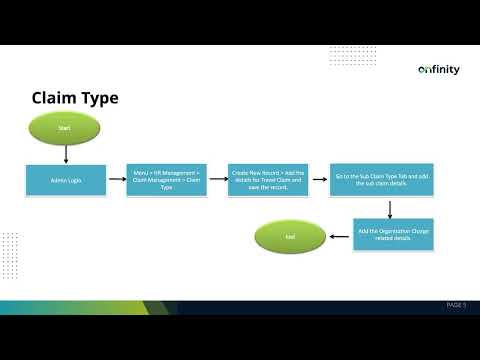
Administrators configure these through the HR Management module, navigating to Claim Management and then the Claim Type screen. The system includes predefined claim types, but also supports custom classifications. When selecting a standard claim type like travel, the system auto-populates subclaim options. For custom claims, administrators select the claim type as ‘Other’ and manually enter both claim and subclaim names.
This hierarchical structure gives finance teams granular control while keeping configuration centralized. A travel expense reimbursement system built this way ensures that employees submit claims knowing they fall into the right category, reducing errors and back-and-forth with finance.
Linking Claims to Organization Charges and Cost Centers
Every subclaim must be tied to an organization charge, which determines how the expense is posted in the financial system. Onfinity allows administrators to assign cost centers at the subclaim level or pull them automatically from employee work information. This means finance teams can choose whether to apply a universal cost center from the employee record or define a specific one for certain claim types.
Organization charges can be set globally using a wildcard or defined separately for each entity in multi-organization environments. This ensures claims are not only processed but also accurately reflected in financial reports and budget tracking. The charge master module supports this by maintaining all predefined charges used across claim types. If a charge is missing, administrators can add it directly within the claim configuration screen by specifying the charge name, type, and amount.
This connection between claims and financial posting eliminates reconciliation delays at month-end. Finance teams gain visibility into claim volumes, spending patterns, and cost center allocations without manual sorting or spreadsheet exports.
Configuring Standard and Custom Claim Types in Onfinity
Onfinity includes predefined claim types such as travel, medical, gift, mileage, and entertainment. For standard claims, administrators select from the list, and the system auto-populates claim names and subclaim options. Each claim can have validity dates, duration rules, and optional comments for internal tracking.
Custom claims are configured by selecting ‘Other’ as the claim type and manually entering the claim and subclaim names. This flexibility supports both compliance-driven and organization-specific reimbursement policies. For example, an organization might define a work-life balance claim with subclaims that reflect internal wellness programs or remote work allowances.
During configuration, administrators specify whether the employee’s cost center should apply universally or be overridden at the subclaim level. They also define claim duration options such as per trip, per day, per month, or per annum. For per trip claims, the system requires a trip date to determine eligibility. For per day or per month durations, the trip date field becomes read-only, and the system calculates eligibility based on the claim period.
This level of control ensures that ERP claim configuration matches the actual reimbursement policies in place, rather than forcing policy changes to fit system limitations.
What This Means for Finance Operations and Employee Experience
When claim types are configured correctly, employees submit claims knowing they fall into the right category. This reduces errors and eliminates the need for finance teams to reclassify submissions manually. Automated posting to the correct charges and cost centers means reconciliation happens in real time, not at month-end when discrepancies are harder to trace.
Finance teams gain visibility into claim volumes, spending patterns, and cost center allocations without exporting data or building custom reports. Multi-organization support means global enterprises can standardize processes while respecting regional variations in policy or currency. By configuring claims once in Onfinity, organizations avoid spreadsheet-based workarounds and disconnected approval workflows that introduce risk and delay.
For HR operations heads and finance directors, this translates into fewer exceptions, faster approvals, and cleaner financial records. For employees, it means faster reimbursements and fewer rejections due to miscategorization.
Watch how this works in Onfinity ERP:
See Claim Configuration in Action
If your team is still managing employee claims across spreadsheets or disconnected systems, Onfinity centralizes claim types, subclaims, and organization charges into one configurable workflow. Request a demo to see how it works for your organization, or follow us on LinkedIn for more insights on ERP-driven finance operations.