
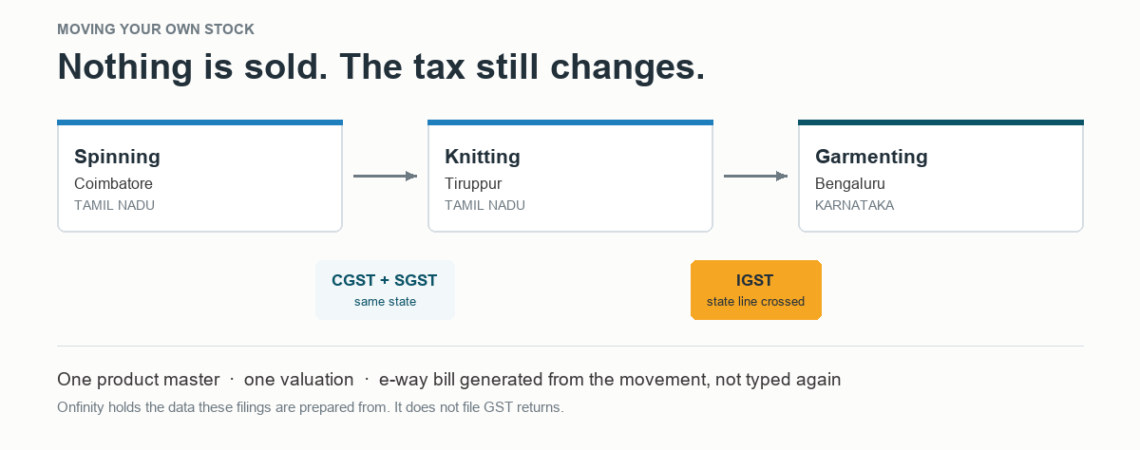
A lot of Indian manufacturing groups are not one factory. Spinning sits in one state,
knitting in another, and the garmenting unit is somewhere else again. Auto components
look the same: machining in one place, assembly in another, a warehouse near the
customer.
Nothing is sold when material moves between those units. It is your stock the whole way.
The tax system does not entirely agree.
The movement is a taxable event
A transfer between two units of the same business, registered separately in different
states, is treated as a supply. Tax applies. Because the two ends are in different
states, it is integrated tax rather than the split central and state tax that applies
within one state.
That has two practical consequences and both bite at month end.
The first is that the tax charged depends on where each end of the document sits, not on
what is being moved. The same fabric, going to the same finishing unit, is taxed
differently depending on which of your plants it left from.
The second is that this is a document, not a note. It needs to exist, be numbered, be
reconcilable, and match the goods that physically moved.
Where it usually goes wrong
The transfer is recorded as an issue. The material leaves stock at the
sending unit and gets received at the other end as though it appeared. Group stock is
understated in between, and the two ends carry different values for the same thing.
The paperwork is produced somewhere else. The movement is in the system,
the e-way bill is generated on a portal, and the two are connected by somebody
remembering. When a trip is cancelled, one of them gets updated.
Each unit keeps its own item master. The same yarn has three codes
because three units set it up independently. Group-level stock is then an exercise in
matching names, done in a spreadsheet, once a month, by the person who is best at it.
What it should look like
The unit is an organisation inside one system rather than a separate installation. Each
has its own books and its own registration. They share one product master, so yarn is
one item wherever it sits.
Tax on a movement is worked out from the state at each end of the document. Within a
state it splits; across one it does not. Nobody decides that per transfer, because the
document already knows where it came from and where it is going.
The e-way bill is generated from that same movement rather than typed again on a portal,
and cancelled from it when the trip is called off. There is one record of what moved and
the paperwork is a view of it.
Stock is valued once. A transfer changes where the material is, not what it is worth.
The group total is a total, not four spreadsheets added up with a note
about timing differences.
What this does not do
It is worth being exact, because compliance is where software gets oversold. Onfinity
holds the data these filings are prepared from, and generates e-way bills and
e-invoices against documents that already exist in the system. It does not file
GST returns. The filing remains where it is today.
The test
Take one inter-unit transfer from last month. Ask three questions.
What was the material worth at the sending unit, and what was it worth at the receiving
one? Were the e-way bill and the stock movement created from the same record, or typed
twice? And if somebody asks what the group holds of that item today, across every unit,
how long does the answer take?
If the last one takes more than a minute, that is not a reporting problem. It is four
systems wearing one company’s name.
Manufacturing across units
·
Stock and movements
·
Download the free edition