
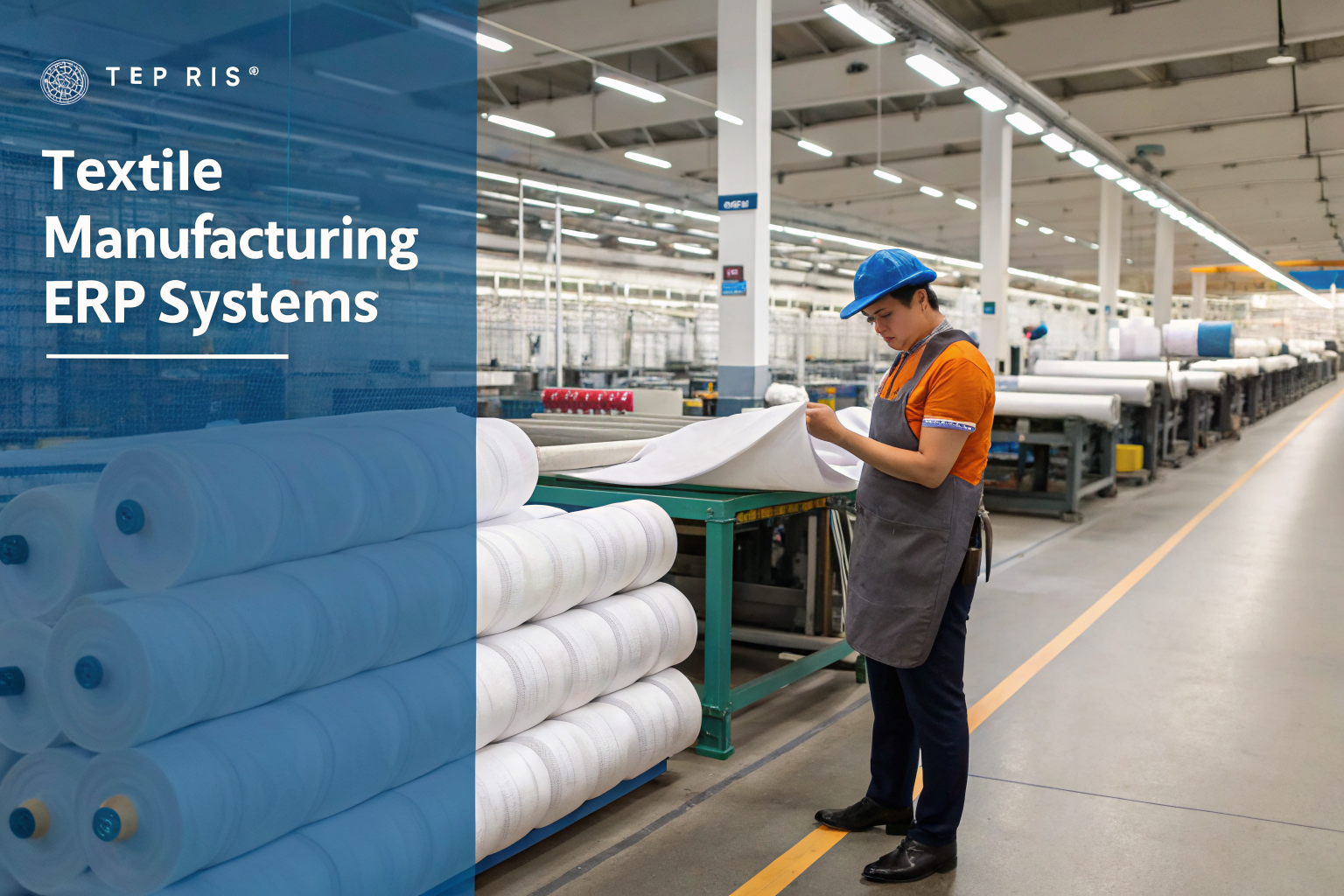
Textile manufacturers face a recurring problem: production costs and inventory levels are fragmented across multiple systems and spreadsheets, making it nearly impossible to know the true cost of goods or the actual stock position until the month is nearly closed. Finance teams spend days or weeks reconciling data from cutting floors, sewing lines, and finishing departments—only to discover variances they cannot explain. An integrated ERP for textiles closes this gap by capturing production movements and cost allocations in real time, so you have visibility into margin drivers and inventory accuracy the moment work is completed.
The alternative is familiar: spreadsheets, email handoffs between departments, and month-end surprises that force emergency meetings and delayed close cycles. This article walks through how textile manufacturers restore operational control and financial accuracy using integrated production workflows.
The Cost Visibility Problem in Textile Manufacturing
Textile production is deceptively complex from a costing perspective. Raw fabric arrives at fluctuating prices; as it moves through cutting, sewing, and finishing, waste and scrap accumulate at each stage. Labour hours vary by fabric weight and stitch count. Quality rejects appear unpredictably. At the end, you need to know the actual cost of each finished roll—but the data to calculate that sits in separate places: fabric purchase invoices in accounts payable, production logs on a supervisor’s clipboard, inventory counts in a spreadsheet, scrap weights recorded on a warehouse whiteboard.
Finance teams typically spend 40% of month-end closing just reconciling production data. A batch of fabric moves from raw storage to cutting, then to sewing, then to finishing—but the handoffs between departments create data gaps. A roll may be counted twice, lost between locations, or rework cycles may not be documented. By the time the variance report is compiled, weeks have passed, making it too late to correct the overstock or understock decisions that led to the problem.
Compliance reporting adds another layer. Textile manufacturers must track dye lots, verify weight, document quality marks, and maintain audit trails for customer recalls. These requirements are often managed in parallel spreadsheets or manual filing systems, creating exposure when auditors or customers ask questions.
Why Textile Production Planning Needs Integrated Workflows
Generic manufacturing ERP systems treat all production the same way. Textile manufacturing, by contrast, demands flexibility and traceability at the batch level. Fabric specifications change mid-order—a customer requests a different weight, a dye lot runs short, or a colour test fails. Your system needs to handle flexible bill of materials, not rigid product structures locked at order entry.
Batch traceability is non-negotiable. Each roll of fabric must map back to the raw material supplier, the production date, the operator, the dye lot, and the quality inspection result. If a customer reports a colour issue six months after delivery, you need to retrieve that production record in minutes, not days. The same applies to internal rework: if a batch fails inspection, you need to track what happens to it—returned to raw inventory, reworked, or scrapped—so your costing is accurate.
Yield loss occurs at every stage. Selvage waste in cutting, thread offcuts in sewing, and rejects in finishing all reduce the amount of saleable fabric. Without real-time capture, these losses are buried in consumption variance at month end. With integrated workflows, each loss is recorded at the point of production, so you can see which department is driving cost drift and whether your standard cost assumptions are still realistic.
Production scheduling also depends on real-time visibility. Without accurate material availability and queue management, changeovers multiply and throughput drops. Operators spend time on manual setup instead of focused production.
Building Cost Accuracy from Raw Material to Finished Goods
Costing in textile manufacturing requires a chain of accurate transactions, not estimates or manual calculations. The process begins at goods receipt. When fabric arrives from a supplier, it is inspected for weight, count, and defects. If the actual weight differs from the bill of lading, that variance is recorded immediately and flags the cost basis. You discover a problem at receipt, not at month end when you are trying to reconcile inventory.
Job costing then captures the labour and material consumed per batch. When a roll is cut, the system records the quantity of fabric drawn down, the waste generated, and the labour hours. When cut pieces move to sewing, the system records trim usage, labour hours, and any quality rejects. By the time the finished roll reaches quality hold, all cost elements are captured in a single transaction chain. There is no separate manual entry; the cost calculation happens automatically.
Standard costing provides a benchmark. You set a standard material quantity, labour rate, and overhead allocation per SKU. As actual production occurs, the system compares actual to standard, highlighting variance by production stage. If cutting labour is running 15% over standard, that signal reaches the production manager in real time, not in a variance report two weeks later.
Finished goods costing rolls up fabric, trim, labour, and overhead per unit without manual spreadsheet calculation. Scrap and waste material is tracked to cost centre—cutting waste segregated from quality rejects, so you can see where inefficiency is concentrated and whether it is a process control issue or a supplier quality issue.
Inventory Control Without the Manual Reconciliation Cycle
Manual inventory counts and reconciliation are a symptom of disconnected systems. When production movements are recorded at operation completion—not batch-entered at month end—your perpetual inventory stays synchronized with actual warehouse transactions. Physical counts align to system records, and variance investigations, when they do occur, point to a specific production date or batch instead of a vague month-long discrepancy.
Real-time visibility also accelerates decision-making. Slow-moving fabric SKUs become visible within 48 hours of production. Instead of discovering overstock during quarter-end, you can adjust future cutting schedules or offer the fabric to customers before it ages further. Returns and rework are traced back to the original batch and cost centre, so warranty and scrap reserve adjustments are booked with supporting detail, not estimated globally.
Multi-location tracking prevents inventory from being “lost” between the raw material store, work-in-progress areas in different departments, finished goods hold, and customer shipment. Each movement is recorded, so a physical count reconciles quickly.
Compliance and Quality Tracking at Production Speed
Textile manufacturers face compliance requirements that demand depth: dye lot traceability, weight certificates, quality inspection sign-off, and expiry rotation. Each batch records its dye lot, weight range, quality inspection result, and approval. This data flows automatically to invoices and shipping documents, eliminating the manual copy-and-paste work that creates transcription errors.
Quality hold rules prevent goods from moving forward until they pass inspection. A batch that fails a GSM test or shows colour variance is held automatically, with escalation to the quality manager. The system enforces discipline instead of relying on an email reminder that gets lost.
Supplier quality metrics accumulate in the system: rejections per delivery, variance from specification, weight drift. These metrics feed directly into vendor scorecards and reorder decisions, replacing the informal memory or email chains that typically drive supplier performance.
Certificate of analysis records are embedded in batch data, retrievable for customer audits without separate filing. Expiry and rotation rules prevent older fabric being used after dye lots expire or colour matches drift.
From Disconnected Systems to Closed-Loop Production Finance
When operations and finance are connected, finance teams move from investigation mode to explanation mode. Variances surface in real time. A production cost spike is visible within days, giving you time to understand whether it is a one-time material spike or a process control drift that needs correction.
Pricing and margin decisions can now use actual cost data from the previous week’s production, not month-old standard costs or rough estimates. If fabric prices surge, you can recalculate your landed cost and adjust customer pricing before margins erode further.
Cash flow forecasting improves because work-in-progress and inventory levels are known daily. Payment timing aligns to actual stock position, not guesses. Monthly P&L close accelerates by 3 to 5 days because production costs are complete and verified in the system, not waiting for manual cut-off and accrual adjustments.
Board reporting includes production efficiency metrics—cost per unit, scrap percentage, yield percentage—with confidence, because the source data is transactional, not compiled from emails and spreadsheets. See how production costing and inventory workflows integrate in a working system.
Building the Foundation for Sustainable Margin Control
The real value of integrated production workflows is not just faster reporting; it is sustainable margin protection. When you can see cost drivers in real time, you can adjust processes before small inefficiencies compound. When batch traceability is automatic, quality issues are caught and resolved without customer escalation. When inventory is accurate, you avoid markdowns and obsolescence.
Textile manufacturers who have moved from spreadsheet-based production tracking to integrated ERP workflows report that their month-end close cycles shorten by a week or more, their scrap and waste percentages drop within the first quarter, and their variance investigation time falls from hours per issue to minutes. The system does not eliminate variance; it eliminates the lag time between when variance occurs and when you can act on it.
If your team is still managing textile production costs and inventory reconciliation across disconnected systems, there is a more direct path forward. Schedule a demo to see how batch tracking, job costing, and real-time inventory work in context. Onfinity is built specifically for textile and apparel manufacturers, so the workflows reflect your actual production reality, not a generic manufacturing template.
The shift from manual reconciliation to integrated production finance is practical, not theoretical. It starts with connecting your production floor to your general ledger and runs through your inventory records. The payoff is visibility, accuracy, and the ability to close your books with confidence.
Follow Onfinity on LinkedIn for more insights on manufacturing finance and ERP workflows for textiles and apparel.