
Why Claim Eligibility Rules Matter for Growing Organizations
When finance teams manually verify every travel or expense claim against employee grade or role, approval cycles slow down and inconsistencies creep in. A trainee booking a flight receives the same scrutiny as an executive, even though their reimbursement limits differ significantly. Without predefined rules, every submission becomes a judgment call, leading to employee dissatisfaction and compliance gaps.
Employee claim management systems address this by allowing administrators to configure who can claim what amount under which conditions. Onfinity ERP automates eligibility validation by tying reimbursement limits to employee grade, position, or job role. Once configured, the system applies the correct limit when employees submit claims—no manual lookup required.
Organizations benefit from centralized control over claim policies. Finance teams gain visibility into reimbursement trends, HR teams reduce approval overhead, and employees receive clear guidance on what they can claim based on their level.
How Onfinity ERP Structures Claim Eligibility by Employee Grade
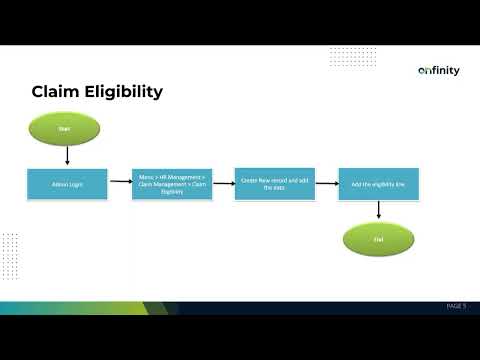
Administrators navigate to HR Management, then Claim Management, and open the Claim Eligibility screen. Each claim type—such as travel—can have multiple subclaims like air tickets, accommodation, or public transport. For air ticket claims, Onfinity allows setting different eligibility amounts per grade: trainee employees receive ₹12,000 per trip, entry-level staff receive ₹15,000, mid-level employees receive ₹18,000, senior-level employees receive ₹20,000, and executives receive ₹25,000.
Accommodation eligibility operates similarly, configured as daily allowances. A trainee receives ₹1,200 per day, entry-level staff receive ₹1,500, mid-level employees receive ₹1,800, senior employees receive ₹2,000, and executives receive ₹2,500. Once saved, the system automatically applies the correct reimbursement limit when employees submit claims, eliminating manual verification.
This grade-based approach ensures that travel reimbursement eligibility criteria align with organizational policy without requiring finance teams to cross-check every submission against internal guidelines.
Defining Position-Based and Job-Based Eligibility Rules
Some claims apply based on position rather than grade. Work-life balance benefits, for example, may be tied to specific roles regardless of seniority. Administrators select ‘position’ as the eligibility criteria, and the system enables position selection instead of grade. Employees in the same position receive identical claim amounts, even if their grades differ.
Organizations can also use ‘job’ as the basis for eligibility, depending on how roles are structured internally. Onfinity supports organization-wide eligibility using a wildcard symbol, or organization-specific rules for multi-entity setups. This flexibility allows companies to align claim policies with their unique organizational structures.
Setting Up Eligibility Lines and Currency Handling
After creating the main eligibility record, administrators move to the Eligibility Line tab to define amounts per grade or position. Each line includes a start date, optional end date, unit of measure (amount), and currency. The currency defaults to the organization’s base currency, such as INR. If a different currency is needed, administrators mark it as ‘my currency’ in the currency configuration screen.
For fixed allowances like public transport—₹10,000 per month for all grades—the same amount is entered across all eligibility lines. The system auto-populates organization and claim name fields, reducing manual entry and errors. HR claim processing configuration becomes straightforward once these lines are defined, as the system references them during claim validation.
Real-World Use Cases: Travel, Accommodation, and Transport Claims
Air ticket eligibility ensures executives can book higher-cost flights while trainees stay within budget limits. Domestic accommodation claims are handled as daily allowances ranging from ₹1,200 to ₹2,500 based on employee level, simplifying approval workflows. Public transport allowances remain consistent at ₹10,000 per month for all grades, reflecting uniform benefits.
When an employee submits a claim, Onfinity automatically validates the amount against their grade or position eligibility. If a mid-level employee submits an air ticket claim for ₹18,500, the system flags the excess ₹500 beyond their ₹18,000 limit. Finance teams gain visibility into claim trends and can adjust eligibility rules as policies evolve without reconfiguring individual employee records.
This automation reduces approval time and ensures consistent application of travel reimbursement eligibility criteria across departments and geographies.
Key Considerations Before Configuring Claim Eligibility in Onfinity
Before configuring eligibility, ensure that grade, position, job, and claim type masters are already defined in the system. Decide whether eligibility should be based on grade, position, or job—this determines which field drives reimbursement limits. Use start and end dates to handle policy changes, seasonal allowances, or temporary benefits.
Test eligibility rules with sample claims before rolling out to all employees to avoid miscalculations. Onfinity’s unified claim management module ensures that eligibility, submission, and approval workflows are tightly integrated, so changes to eligibility rules immediately affect new claim submissions.
Ready to Automate Claim Eligibility?
If your team is still validating claim eligibility manually or struggling with inconsistent reimbursement approvals, Onfinity ERP centralizes eligibility rules and automates claim validation. Request a live walkthrough to see how eligibility configuration works in practice, or follow us on LinkedIn for more insights into unified ERP workflows.