
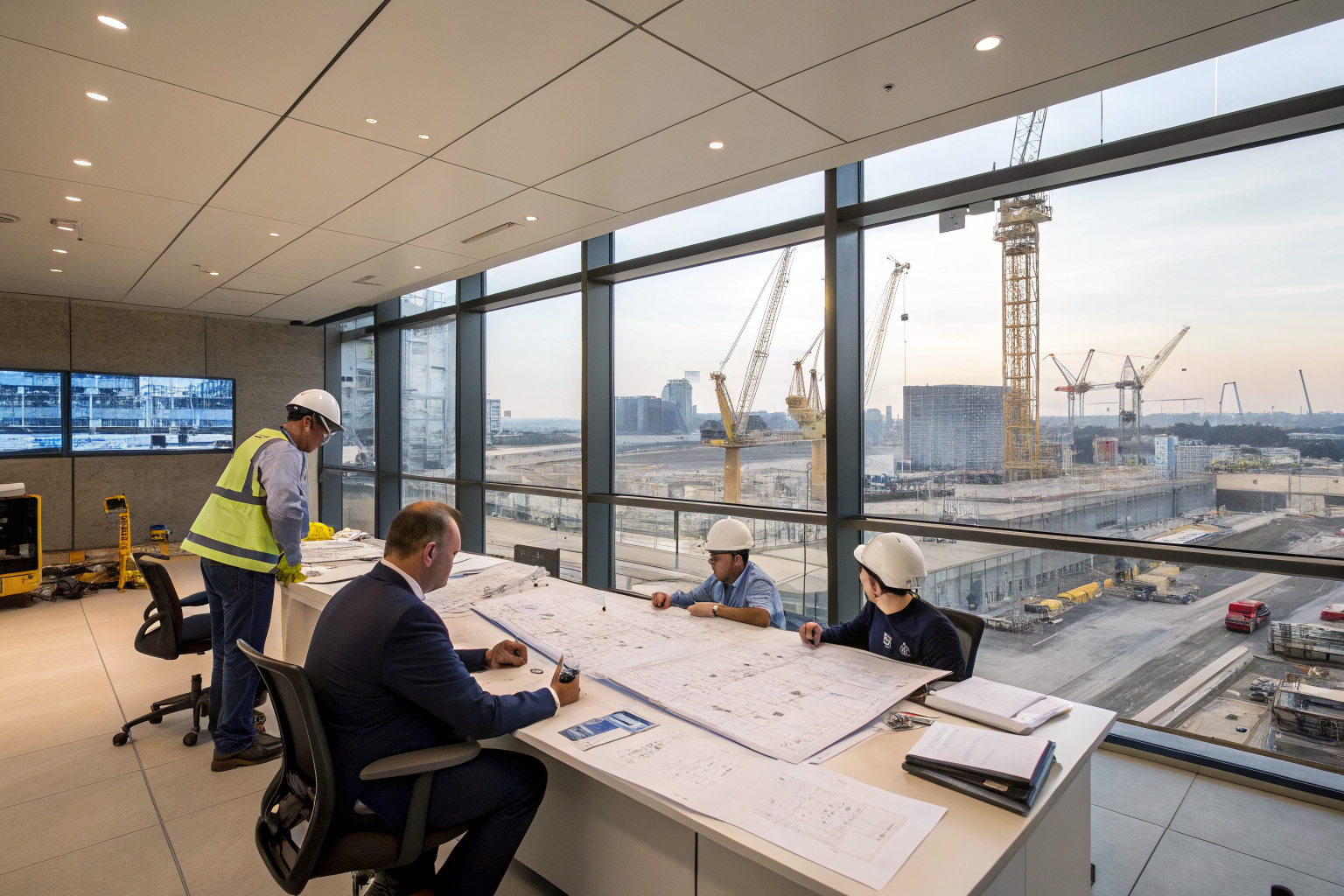
Managing costs across large infrastructure projects—whether a multi-year transport programme or a major civic development—exposes a fundamental friction point: cost data lives everywhere except where it needs to be. Finance teams reconcile numbers from spreadsheets, site logs, email threads, and legacy systems; operations teams discover budget problems weeks after they’ve materialised; and stakeholders lose confidence in forecasts that shift mid-project. AI-driven project costing for large-scale infrastructure projects changes this calculus by connecting live project actuals to continuous cost intelligence, so finance and operations teams respond to variances before they compound into overruns.
The gap between manual cost tracking and real-time visibility is not a technology problem—it’s an operational one. Teams know what they should be doing; they lack the connected data and immediate signals to do it consistently. This article walks through how that friction manifests, why traditional ERP cost modules fall short at infrastructure scale, and how AI-driven costing embedded in an integrated ERP actually works in practice.
The Hidden Cost of Manual Project Costing in Large Infrastructure
Large infrastructure projects generate cost data continuously: timesheets from multiple sites, purchase orders flowing to suppliers, invoices arriving weeks after delivery, change orders approved mid-phase, sub-contractor claims requiring reconciliation. In most organisations, this data lives in disconnected pockets. A project director tracks spend through site reports and email updates. Finance consolidates numbers monthly, discovering actuals that are now two to three weeks old. By the time a variance is spotted and escalated, the team has already committed further spend against the original assumption.
The reconciliation burden is real. Finance spends days each month chasing actuals, validating numbers, and rebuilding forecasts manually. Operations teams lack early signals; they discover cost issues when variance reviews surface them, not when they first emerge on site. Budget forecasts become increasingly unreliable as projects progress—not because estimates were wrong initially, but because they’re based on outdated actuals and don’t account for the patterns that emerge (labour productivity shifts, material inflation, schedule compression) until late in execution.
Stakeholder confidence erodes fastest when revised forecasts arrive unexpectedly. A mid-project reforecast that pushes completion costs up by 10% signals either poor initial planning or poor cost control. Either way, sponsors and lenders question the team’s ability to manage the programme. Contingency reserves grow fat because finance has no confidence in forecasts—so they lock up buffer capital rather than release it back to the business.
Why Traditional ERP Cost Modules Fall Short for Infrastructure Scale
Standard ERP cost accounting was designed for stable manufacturing or service environments. Costs roll up linearly, cost codes remain fixed, and variance analysis happens at month-end. Large infrastructure projects operate under different physics. Labour productivity varies by phase and site condition. Material inflation hits at unpredictable intervals. Sub-contractor networks introduce multiple billing points, unit-rate variations, and reconciliation complexity. Schedule acceleration creates cascading cost impacts that static cost codes cannot capture.
Traditional ERP modules track actuals accurately but offer no intelligence about what those actuals mean. A labour variance shows that site costs ran 6% over plan—but the system doesn’t tell you why. Was it productivity decline? Rework? Unexpected ground conditions that the contract allows as a variation? Did the same variance happen on a similar past project? Should you expect it to continue, or was it a one-time event? Finance re-enters data, recalculates forecasts, and updates spreadsheets manually, while the cost drivers that matter remain hidden in the detail.
Multi-phased projects with distributed sub-contractor networks require dynamic cost allocation—adjusting for real-time actuals, contract variations, and risk events. Rule-based ledger logic cannot learn from those patterns. Cost-to-complete estimates require re-entry and recalculation; there is no continuous learning from historical actuals that might improve future forecasting. Compliance trails and audit records exist, but cost intelligence does not.
How AI-Driven Costing Ingests Live Project Data
AI-driven costing systems operate on a different principle: they ingest live cost signals continuously and apply pattern recognition to surface what matters. Instead of waiting for monthly data dumps, the system reads timesheets as they’re recorded, flags purchase orders and invoices as they arrive, and incorporates site logs and change orders in real-time. There is no weekly upload, no manual consolidation, no lag between actuals and visibility.
The system flags anomalies instantly against multiple benchmarks. A labour rate spike on a Monday morning gets compared to historical rates for that crew, rates on similar sites, and peer benchmarks from comparable past projects. If it’s an outlier, finance sees an alert. A material invoice 15% above the agreed unit rate surfaces for validation. Site productivity trending downward across a phase—tracked through timesheets and task completion logs—appears as a pattern, not an isolated variance. None of this requires manual analysis; the system surfaces it.
AI-driven costing learns from historical cost drivers. If past projects of similar scale and geography show that labour costs typically spike during a particular phase, or that material inflation follows a predictable curve, the system incorporates those patterns into cost-to-complete forecasts for the current project. These forecasts update automatically as actuals come in; finance receives alerts when variance thresholds are breached, not static monthly reports that are outdated by the time they’re reviewed.
The audit trail remains complete and transparent. Every cost is traceable to its source (timesheets, invoices, site logs), broken down by phase, resource type, sub-contractor, and cost code. Finance maintains control; the AI suggests, but humans validate and act. That separation is critical for regulated infrastructure projects where cost changes require approval and evidence.
Operational Clarity: Real-Time Cost Intelligence in Action
On a Monday morning, a project director opens the cost dashboard and sees that Phase 2 labour is running 8% over plan—not months into the phase, but flagged in week three. Instead of waiting for a monthly variance review, the director has a conversation with the site manager that same week. Was productivity lower than expected? Are ground conditions driving extra effort? Is the crew size appropriate? The conversation happens while the phase is still underway, not after the spend has been locked in.
Finance no longer reconciles numbers across systems. Instead, they validate AI anomalies and adjust assumptions if warranted. If material inflation is running higher than the model anticipated, they adjust the cost-to-complete. If a change order justifies a labour variance, they document it and close the alert. This shifts finance from transaction processing to judgment and control—higher-value work that actually impacts decision-making.
The CFO presents rolling forecast accuracy to the board with real numbers backing it. Organisations that implement AI-driven costing typically see historical variance between forecast and actual shrink from ±12% to ±3%. That accuracy changes how stakeholders view the programme. Revised forecasts still happen, but they’re rare and smaller; they’re not a signal of poor control, but of good data.
Sub-contractor billing becomes almost frictionless. Invoices reconcile automatically against agreed unit rates and actual volumes recorded on site. Disputes are rare because actuals align with the contract. Cost contingency reserves become evidence-based rather than guesswork; if historical variance is ±3%, you don’t need to lock up 8% buffer.
Business Value: From Budget Control to Strategic Foresight
Earlier variance detection prevents scope creep from becoming cost overruns. Change requests still happen—that’s infrastructure—but their cost impact is visible immediately. A team can approve a change and adjust the forecast in the same conversation, not discover three weeks later that it’s driven a budget variance.
Accurate cost-to-complete forecasting improves cash flow planning. If you know with confidence that a £200m project will cost £205m to finish, you can plan working capital and phased funding precisely. You don’t need to reserve extra buffer or ask sponsors for unplanned capital calls mid-project. That confidence translates to lower cost of capital and faster stakeholder approvals.
Portfolio visibility across multiple concurrent projects enables resource reallocation before bottlenecks materialise. If one project is running ahead of schedule and will release labour soon, and another is approaching a resource-intensive phase, you can plan the transition. That kind of strategic visibility is impossible when cost data is fragmented across spreadsheets and site reports.
Finance and operations alignment improves because both teams work from the same cost data, updated in real-time. The political friction over “whose numbers are right” disappears when there’s a single source of truth.
Embedding AI Costing into Your ERP Workflow
An integrated ERP platform connects live project data to cost intelligence by eliminating the manual consolidation steps that create delay. Timesheets, procurement, and invoicing flow into a single cost ledger. Cost models run continuously against live actuals; there’s no monthly batch reconciliation or year-end restatement surprises. The AI layer surfaces cost drivers—labour productivity trends, material inflation, schedule acceleration—as operational signals that operations teams can actually act on, not buried in variance reports that Finance presents weeks later.
Finance maintains control throughout. AI suggests cost adjustments or flags emerging variances, but humans validate and approve. That control is essential for regulated infrastructure where every cost change requires evidence and sign-off. A structured ERP with AI-driven costing can eliminate the friction of chasing cost data across spreadsheets and emails while keeping governance intact.
The system scales with project size and complexity. Whether you’re managing a £50m civic project or a £500m transport programme, data fidelity and forecast accuracy remain consistent. The architecture supports distributed teams, multiple currencies, and complex sub-contractor networks—all feeding into a unified cost model.
Taking the Next Step
If your finance and operations teams are still chasing cost data across spreadsheets and emails during large infrastructure projects, a move to AI-driven costing within an integrated ERP removes that friction entirely. You’ll forecast accurately, respond to variances before they compound, and give stakeholders the confidence that comes from real-time, evidence-backed cost visibility. Request a demo tailored to your project scale and complexity to see how this works in practice—or explore how Onfinity ERP connects live project actuals to continuous cost intelligence across multiple concurrent projects.
The operational shift is straightforward: stop chasing numbers, start managing strategy. That’s where AI-driven costing in a connected ERP makes its real impact.
Follow us on LinkedIn for insights on ERP workflows and infrastructure project management.