Warehouse management · India
Warehouse management (WMS), from the bin to the lorry
Stock control tells you what you own. This is the other half. Who picks it, from which bin, in what order. And what actually went into the box. Built for godowns where the picking list is still a printout.
Book a demo How picking worksWhat a picker is given
The task says where to go, and records where they went
A picking task names the product, the bin it should come from and the bin it should go to. What the picker actually did is recorded beside what was suggested. The two can differ, and you can see it.
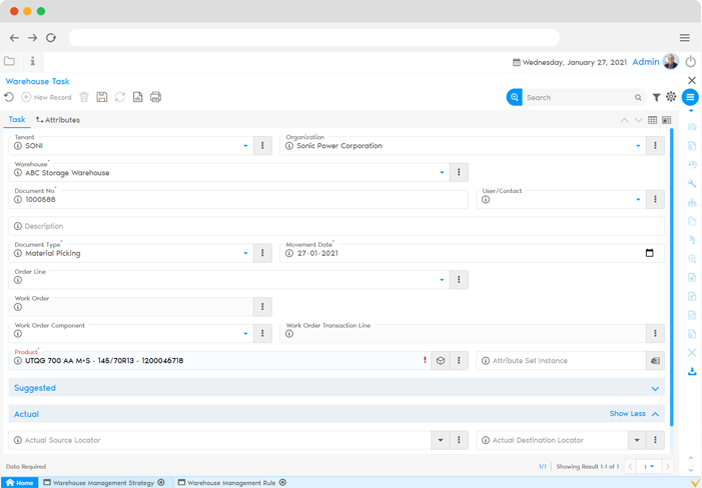
That gap between suggested and actual is the whole point. It is where you find the mislabelled bin. The shortcut a picker takes every day. The aisle where stock keeps going missing.
Picking many orders at once
Wave picking: one walk, many orders
Picking one order at a time means walking the same aisle forty times a day. A wave groups the orders together and sorts the list the way the warehouse is actually laid out.
- A wave belongs to a warehouse
- It has its own document number. A supervisor can hand out a wave and ask about it later by name.
- Sorted the way you choose
- The sort rule is set per document type. Pick by aisle, by customer, or by despatch time, depending on what the day looks like.
- Rules and strategies, not habits
- Put-away and picking follow rules you set once. Not what the senior storekeeper happens to remember.
Between godowns
Moving stock between godowns is two facts, not one
Material leaving one godown and material arriving at another are separate events. On a bad day they are separate quantities. Onfinity records the movement, then the confirmation.
- What left, and what arrived
- The difference is visible instead of quietly disappearing into the next stock count.
- Stock in transit is somewhere
- Between the two godowns the material is still yours, and the system can say where it is.
- Bins under godowns, godowns under companies
- Two branches counting separately still add up to one number at the top.
Out of the door
Packing: what actually went in the box
A delivery can be several packages. A customer short one carton needs an answer about that carton, not about the order.
- Packages against the delivery
- Each package carries its own lines. A claim gets answered by opening the record, not by ringing the driver.
- The e-Way bill comes off the same despatch
- Goods do not leave without one, and it is raised from the delivery going out. Stock, batches and the e-Way bill.
- The invoice follows the delivery
- What was despatched is what gets billed. Short shipments do not turn into full invoices.
Bring one day of picking lists.
How many orders went out, how many people picked them, and how far they walked. The saving is usually in the order of the list rather than the speed of the people.
Book a demo Stock and the e-Way billUseful to have ready
- How many godowns, and whether stock moves between them
- Whether bins are labelled today, and by whom
- How a picker is told what to pick
- What happens when a customer says a carton is missing