Order management · India
From the quotation to the invoice
One order can hold stock, a service, a contract, and something you still have to make. Each line goes its own way. The customer sees one order, and hears from you at every step.
Book a demo What a line becomesWhere it starts
A sales quotation that knows where it came from
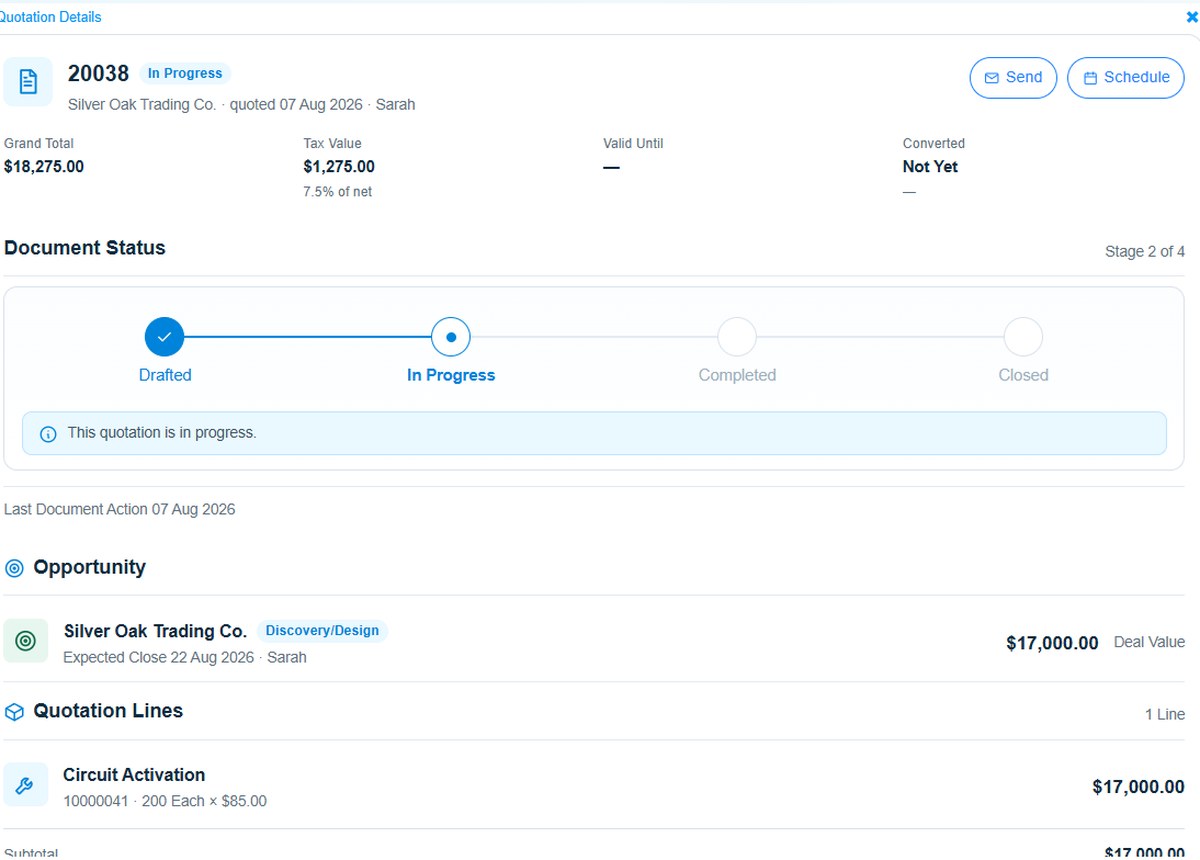
The quote is joined to the deal it came from. You can see what stage it is at, and what it is worth. Send it, or book the follow-up, from the same screen.
One order, four kinds of line
One sales order, four kinds of line
Most orders are mixed. A machine, the work to commission it, and a year of maintenance are three different jobs. They arrive on one piece of paper. Each line knows which job it is.
- From stock
- Reserved, picked, packed, sent. You decide. Hold the order until it is complete, send each line as it is ready, or push it out anyway.
- Made to order
- The line raises a job on the shop floor. That job carries the order and the line it belongs to, the whole way through.
- A service
- Nothing moves in the store. The line is delivered as work done. It is billed on the same order as the goods.
- A contract
- The line creates a service contract with its own billing plan. Each instalment raises its own invoice when it is due.
Made to order
Make to order: the shop floor knows whose order it is
This is the part most systems lose. A job goes to the floor. The link back to the customer order lives in somebody's head.
The job carries the order
The job holds the order and the line. Ask what a customer is waiting for, and the answer is on screen. Not a call to the floor.
Promise a date you can keep
You can see what the plant can take before the date goes on the quote. Capacity, not hope.
Cost lands on the job
Material, labour, machine time, job work and scrap sit against that order. You learn what the job earned, not just what the month earned.
When the job finishes, the goods already belong to the order that caused them. Nothing has to be matched up later. This page stops at the link between the order and the job. How the work gets planned, and the material behind it, is a subject of its own.
While it is running
Order to cash, without the customer having to ring and ask
Most complaints about an order are not about the order. They are about not knowing where it has got to.
Send it from the document
The quotation, the order confirmation, the invoice. Sent from the record itself, so what went out is on the record too.
Ask them to acknowledge or sign
Share a document to read, to acknowledge, or to sign. Signatures are collected one by one. The history shows what happened.
Every stage has a date
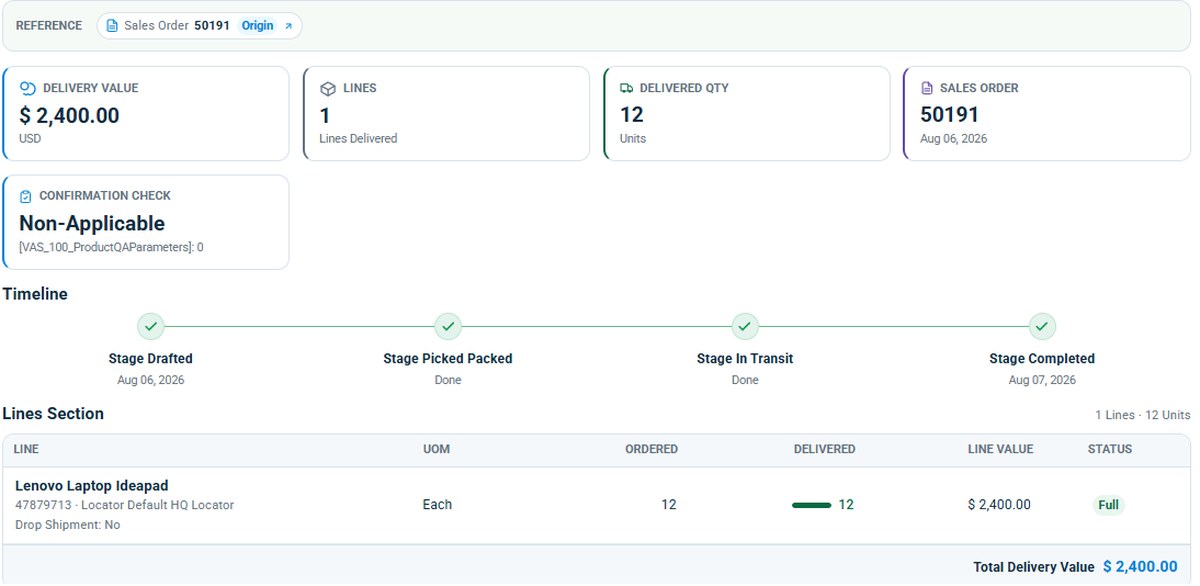
Drafted, picked, in transit, delivered. Each one is dated. An update is something you read off, not something you chase.
Out of the door
Delivery and invoice: despatched against the order
The delivery is made from the order, and says so. The invoice is made from the delivery. Short shipments stay visible. Nothing gets tidied away.
Contracts bill themselves. The plan on the contract raises each invoice when it is due. A year of maintenance does not depend on somebody remembering in month seven.
The step that has to happen
e-Invoice: the IRN comes back onto the invoice
The invoice is registered and the IRN and signed QR code come back onto the record. The document your customer receives is the one that was registered, not a copy of it made afterwards.
- On the invoice, not beside it
- The IRN and the QR sit on the invoice record. Nobody pastes a number from a portal into a spreadsheet.
- GST worked out from the document
- CGST, SGST or IGST follows the place of supply on the order. HSN and SAC codes come off the item.
- Credit notes are documents too
- A return raises its own document against the original, so the invoice and what was actually kept do not drift apart.
Bring one order with a mixed set of lines.
Something from stock, something you make, something you bill monthly. That is the order worth walking through. It is the one that breaks systems.
Book a demo See the whole systemUseful to have ready
- One order with stock and made-to-order lines on it
- A service contract you bill on a schedule
- How you tell a customer where their order is today
- What proportion of your orders are made to order